
Tim Catchpole Chair of the Mortlake with East Sheen Society will now give evidence to the Inquiry at 1150am.
Timetable almost recovered!
Tim Catchpole Chair of the Mortlake with East Sheen Society will now give evidence to the Inquiry at 1150am.
Timetable almost recovered!
Witnesses for the GLA and for the developers have now been taken through their evidence over two days. So we are running late again. This morning Guy Ingham from Carter Jonas is giving evidence on the same topic of viability. Do not expect much variation from the evidence of Mr Lee for the developers.
So those of you who have checked in to the livestream hoping to hear Tim Catchpole from MESS give evidence on planning aspects of the project will be disappointed. We might get to him in the afternoon session.
The annual FiSH Christmas Carol concert will be intergenerational this year! The FiSH Good Afternoon Choir will perform together with the Harrodian School Choir at Christ Church, Christchurch Road, East Sheen SW14 7AW from 1.15pm to 2.30pm on Friday 6th December, led by Carl Speck and Claudie Baum. Join in with festive singing, followed by mulled wine and mince pies.
Tickets are £5.00 and available in advance from FiSH at Barnes Green Centre, or at the door. Doors Open 1pm. More details on our website on https://www.fishhelp.org.uk/news/
Sarah Olney MP obtained leave today (just) to introduce a system of proportional representation for parliamentary elections and for local government elections in England. The motion was adopted by 138 to 136 votes.
A synopsis of her speech follows. The full speech is at Elections (Proportional Representation) – Hansard – UK Parliament
We are experiencing an unprecedented political moment in this country. Our most recent general election, in July this year, returned a Government with the second biggest majority of seats of any Government since the second world war, but on the lowest share of the vote ever recorded for a winning party. The first-past-the-post voting system used in UK parliamentary elections has delivered two thirds of the seats in the House of Commons to the Labour party, which attracted just one third of the votes cast. Thanks to first past the post, nearly 60% of people who voted in the general election in July are not represented in Parliament by the candidate that they voted for. This is the most disproportionate election result that this country has ever seen.
We are also seeing record levels of disillusionment with the political process, with citizens becoming increasingly disengaged. This is reflected in the fact that turnout in the 2024 general election was the second lowest since 1918, at just under 60%. Over 40% of registered voters in the UK thought so little of the political process that they did not think it worth expressing a preference for one candidate over another.
——————————
In the face of growing worldwide threats to democratic Governments and institutions, the UK needs to urgently reassert the value of participative democracy as an essential component in peaceful and prosperous societies. To do that, we need to respond to the democratic challenges that have emerged in our own country by adopting the provisions in the Bill.
In the most recent general election, the number of MPs elected to this Chamber with more than 50% of the votes cast in their constituency was just 96—a decrease from 421 in the 2019 election and 476 in the general election before that. Ten of our colleagues in this Parliament were elected with fewer than 30% of the vote of their constituents who turned out. Far fewer MPs today can say they have the support of the majority of their constituents, or even a broad base of support, than ever before.
Proportional electoral systems have been used successfully for elections in the UK’s devolved Parliaments and Assemblies since the turn of the century. One of the advantages of adopting STV for all local elections in England, as well as general elections, is that it is already in use in two of the four nations that make up the UK. Now Welsh councils also have the power to adopt STV if they wish, it may soon be three out of the four nations. Proportional representation through an STV system is not alien to the UK; millions of people across the country are already familiar with voting in that way.
The all-party parliamentary group for fair elections was launched last week with the support of over 100 MPs. Its report “Free But Not Fair” highlights many of the structural issues that have led to the decline of public trust in politics and engagement with elections.
We must take urgent action to protect democratic processes and institutions in the UK from threats here and abroad. We need to listen to the warning bells sounded by the general election that the citizens we seek to serve, and who must abide by the laws we pass, are becoming disenchanted with the political process. If we want to continue to be a beacon of democracy across the world, we must ensure that it serves its purpose in giving a voice to the people and delivering prosperity and stability. We cannot do the latter if we fail to do the former.
The Inquiry will sit at 9.30am each day from Wednesday, 4th to Friday, 6th December 2024 at Cole Court Centre. Bring warm clothing. Wednesday – heating problem solved.
The Section 106 Agreement and Conditions Round Table Sessions will now take place on Tuesday, 10th December 2024 at Clarendon Hall.
Mr Joseph Ward, a Development Viability Advisor in the Planning Department at the GLA, quoted from a report that stated 67% of unit sales at the comparable Brentford Project had to date gone to foreign buyers.
Add to that the Teddington Riverside Project , also a Reselton development, which still has 50 units of 217 unsold since completion in 2021. In a private communication the Chief Executive of City Developments Limited, of which Reselton is a wholly owned subsidiary, said that he expected those properties to have been sold by March 2025. To whom one might ask?
Late Evidence News
Counsel for the developers said in the course of his cross examination of Mr Ward that his clients, Richmond Council and, it may be assumed the GLA, are working on a new s106 agreement (the fine details of the project) which should be ready over the next few days. The Inspector made it clear that he did not wish to be presented with serial draft agreements.
The key point which emerged was that the s106 agreeement might well include a without prejudice offer to increase the affordable housing to 13%. So it could be that an agreement would be reached which excluded the local community from any discussion of this crucial aspect of the case. Plus ca change.
Meanwhile there was some clarification of the value of the property to be applied in reaching a decision about whether the project was viable. At least from the stance of the developers. Counsel identified the concept of Existing Use Value, which led to a current value of approximately £36 million, largely agreed by Reselton, Richmond and the GLA, rather than the actual purchase price of £158 million.
Please someone issue a correction if necessary. That seems to mean that a developer can pay for land at an inflated price to ensure that he makes the winning bid. Then years later and having miscalculated on delays and negative headwinds, he can persuade the local planning authority to give permission for the development in a way which still ensures that it is the community and not he which suffers the loss.
And that is why there should have been an open debate on which the local community was properly consulted and not a concert party from which it was excluded. Is that what Councillor Roberts meant when he told a local meeting to ‘Get Real’?
Amid the miasma of complex evidence about viability and the level of affordable housing being submitted to the Public Inquiry, readers might be interested to be reminded of some interesting figures on how the the 1085 residential units would be constructed.
These are a total of 1,010 rather than the planned 1,085 units
27 Studio at an average value of £511,111 per unit
271 one bed at an average value of £627, 694 per unit
473 two bed at an average value of £856,818 per unit
221 three bed at an average value of £1,289, 412 per unit
18 four bed at an average value of £1,690,278 per unit
Who will be buying these? How many will go to overseas buyers?
The Inquiry restarted today at Cole Court at 10am. Viability is the key question of the day. Cost of acquisition £158 million. Viability based on £32 million. Why? Let us hope we get an explanation today.
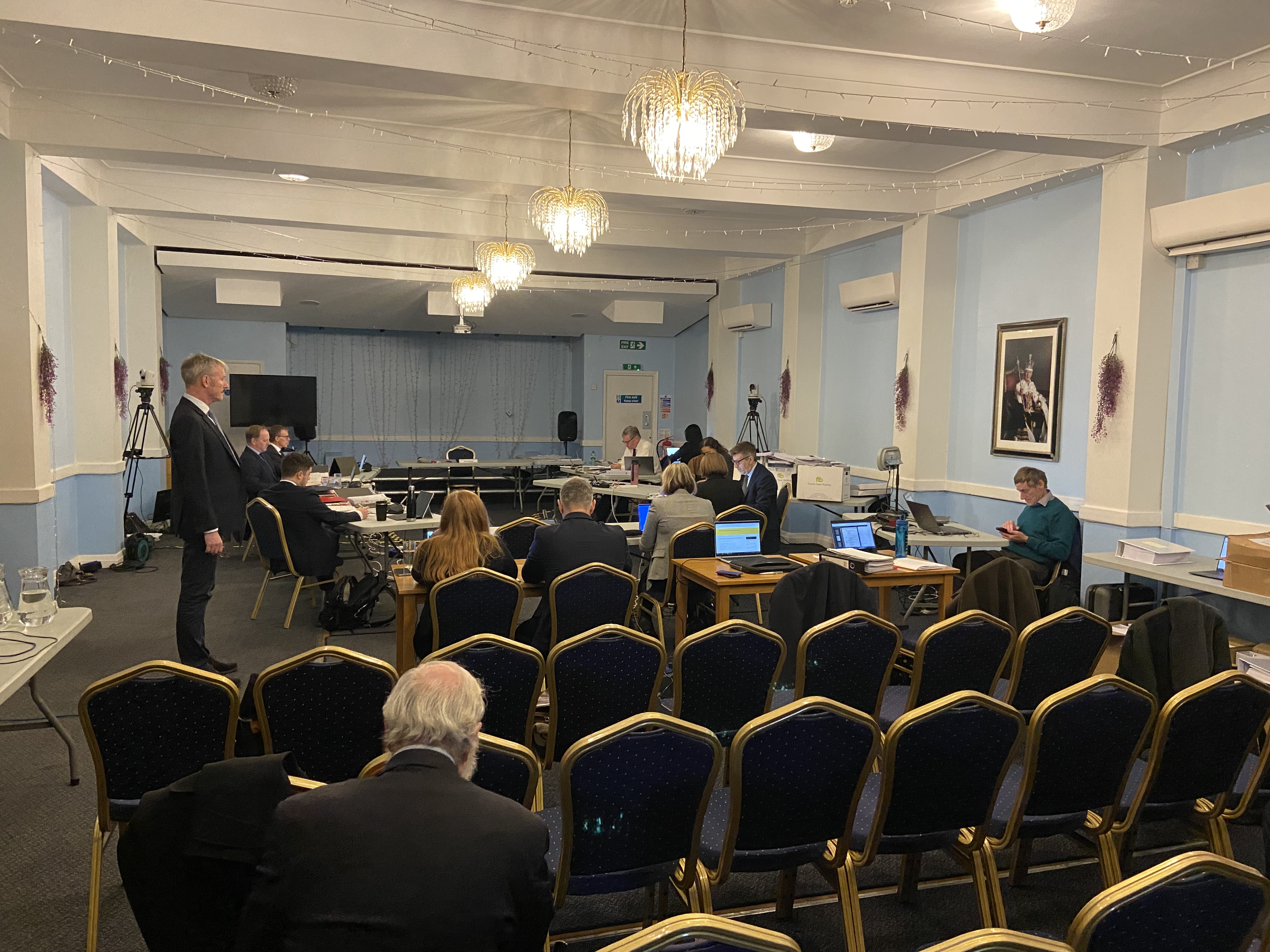
Smaller than Clarendon Hall but adequate. Livestreaming is working. But it could be renamed as Cold Court. The Inspector is wearing his overcoat!
Wifi OK. Evidence to come from Paul Giles on affordable housing, David Seddon on viability and Mark Weston on local need for social housing.
Mothers’ Union Bring and Buy coffee morning at St Mary’s on Saturday 7 December at 10.15am
Macmillan Carol Concert at All Saints at 6.00pm on Saturday 7 December (tickets £15 on the door)
Sarah Olney MP has also reported in her latest weekly newsletter that St George’s, the company behind the proposed Kew Retail Park, has decided to maintain it as retail space “for the foreseeable future”. This means that no plans are in place for a major development of the site.
This may have implications for the Stag Brewery Development. When St. George’s announced its ‘vision’ in 2022 the plan was for 1200 residential units. Richmond Council based part of its calculations of the need for a 1200 pupil secondary school in Mortlake on expected pupils in Kew.
Many already thought that those calculations were exaggerated, but this news would appear to put an additional dent in the Council plans. What will they now be saying to the Department for Education for the purposes of its review of the central government funding of free school projects?


