

Recent Comments
Richard AH White on Get your red flags out inspiring641c639631 on Get your red flags out Richard AH White on Get your red flags out inspiring641c639631 on Get your red flags out butteryluckye3eac174… on Sheen Rocks!
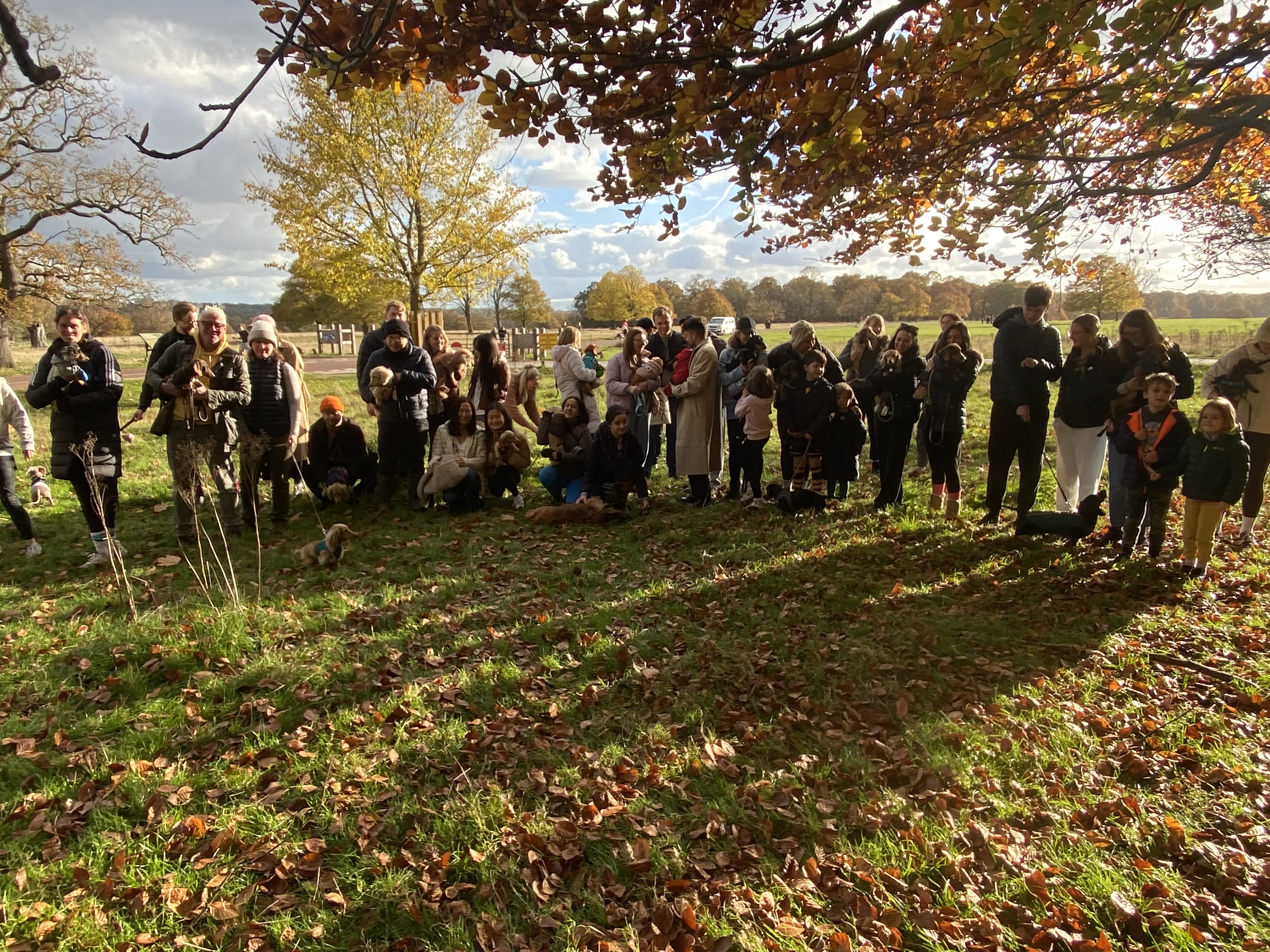
The monthly dachshund collective met for a walk in Richmond Park on Sunday.
The question of the need for a 1200 pupil secondary school is central to the outcome of the Stag Brewery planning applications and appears to be one of the main concerns of many local residents. But it is complicated, given that much of this aspect of the case depends on predictions of future admissions. If you are a statistician or have an eye for numbers you can go to documents filed on the Inspectorate website and the livestream of the evidence session on Thursday 14 November but do not expect an analysis here! The main evidence on this came from Dr Geoff Woodhouse on behalf of the Mortlake Brewery Community Group (MBCG) and Mr Henry Kilpin, Achieving for Children Schools Placement Officer, on behalf of the Council.
It is not the only matter relating to the school. Below is a synopsis. For more detail a good place to start is the Statement of Common Ground (SoCG) to be found at Documents Submitted During Inquiry – Gateley
Background information
Of eleven secondary schools, eight are in the western half of the borough and three are in the eastern half. All are outside Council control; all are currently rated by Ofsted as good or outstanding. For the purposes of school place planning the Council distinguishes between eastern and west of the river.
The scheme for Livingstone Academy is for the erection of a three-storey secondary school with sixth form, for 1,200 students when full, on the west part of the Stag Brewery Site. It includes a new road network around the main development, and the school will be sited off a new road accessed via Lower Richmond Road. Fifteen car parking spaces will be provided to the front (east) of the school. To the south of the building a Multi Use Games Area (MUGA) and habitat area are proposed, and a 3G sport pitch with floodlighting to the west (rear) of the school.
The scheme provides associated external works including landscaping, boundary treatment, cycle parking, new access routes and other associated works. A Community Use Agreement (CUA) will secure the use of the facilities by the local community and sports groups out of school hours and in school holidays, which applies to internal and external sporting facilities.
The developers will provide the land for the new school and play / sports facilities, to be transferred to the DfE, which will be responsible for the delivery of the school.
It is agreed that the school is proposed to have six forms of entry for each year group (180 per year) from Year 7 to Year 11 plus a sixth form (of 300 when at full capacity). Should the proposed school be approved, it would open with a phased approach, a Year 7 cohort in the first year; Year 7 and 8 in the second year; and so on. The school would not be full across all year groups for seven years. Mr Kilpin gave evidence that he did not know when the school might open if planning permission was given.
The DfE expects that free schools should have a sixth form minimum of 200 students, either in the institution or through a partnership. All schools in Richmond that have six or fewer forms of entry, have fewer than 200 students in their sixth forms, all of which have been in operation for 10 years.
The MBCG position is that it is not possible for a non-selective secondary school to support a sixth form containing 300 students when that school admits only six forms of entry. The Council view is that once the school is open, the Academy will retain the ability to decrease the size of the sixth form if necessary, following the process set out by the DfE, either as a significant change or a prescribed alteration.
Secondary School Admissions
The trend to move out of the state-funded sector in Richmond at Year 7 has always been more prevalent in the east than the west, but the figures are not differentiated between them.
The Council say that based on local knowledge of school place planning and anecdotal evidence, there are families who move into the independent sector, or have to accept a school that is not one of their original preferences, or an allocated school within what the DfE considers a reasonable distance. This is because they do not consider they will have any chance of finding a place at a preferred school in the east because they are so over-subscribed and already at, or over, capacity. This is an area of major dispute.
MBCG say that an unpublished number of families resident in the east express a preference for a school at which their child has no chance of obtaining a place on account of that schools popularity and distance from where they live and do not also express a preference for a particular school closer to where they live. In this way they lower the chance of their child obtaining a place at that school which is closer to where they live and is unnamed on their application. It appears to be accepted that no children resident in Richmond are currently not in school. No child has remained unplaced at a secondary school in Richmond at the start of the academic year in September.
The Council says that the reduction in unplaced children does not represent a lack of demand for places, rather families are forced to make a decision to send their child to an independent school or a school which is not a preference, or which may or may not be within what the DfE considers a reasonable distance, to ensure they have a school place before the start of the academic year. This is based on years of knowledge and experience of school place planning in Richmond. This again is a matter of contention.
All the large probable housing developments are in the eastern half of the borough: Barnes Hospital; Ham Close; Homebase, East Sheen; Kew Retail Park (subject to confirmation of proposals / timing being brought forward by the developer and planning permission; and Stag Brewery itself.
Size of the proposed school
The DfE have confirmed they are satisfied with the size of the school taking into account ‘it is not unusual for schools in urban locations such as London, to not meet all the requirements…., particularly for soft and hard outdoor PE and soft informal space. The DfE is content that the school site and design are acceptable’. The Council agrees with this.
MBCG say that it is inaccurate for the DfE to describe the school as being in an urban location, such as London. Mortlake is recognised by the Local Plan and Richmond’s Character Areas as sub-urban, not urban.
Alternative proposals to the new school
The Council say that alternative proposals to the new school were considered and discounted as part of a Local Plan public independent examination in 2018. [There is currently a new Local Plan in draft.]
Support for the new school
The DfE are fully supportive of the need for the new school. The GLA also agree the need for the new school. MBCG say that both the DfE and the GLA decisions were based on evidence provided by the Council, which was in turn based on the forecasting method that the MBCG do not agree with and included other anomalies. It is a matter of contention about whether the figures used are up to date.
MBCG say that there is a decline in numbers in our primary schools by 30% during 2015 to 2024, which will result in a decline in the secondary school population from 2027, so that a new school is not required.
The Council has other considerations in mind:
– the need for more choice, but is choice an entitlement and at what cost one might ask, in view of the potential effect on other local schools and concerns about infrastructure and a lack of transport plans;
– existing demand, a matter of contention;
– future pupil yields from developments on small sites, unknown;
– the increase in immigration, Ukraine and Hong Kong already factored in;
– the forthcoming VAT on private schools, unpredictable.
So the bottom line on this aspect of the case is to what extent you should rely on uncertain predictions to engage in such a major construction.
There is another factor which cannot be dismissed. The DfE pays for the new school, assuming funding is not withdrawn. As Mr Kilpin said in evidence, Richmond Council could not afford to build it. If there was to be expansion of, say Richmond Park Academy, it appears that the Council does not have funding for that in its budget. Of course it would not, because it has stuck to its view since 2016 that Livingstone was its saviour.
Tim Catchpole, Chair of the Mortlake with East Sheen Society, gave the results of their survey to the Stag Brewery Inquiry Inspector on Friday 8th November 2024. The survey was based on a comparison of what Richmond Council state are substantial benefits of the development. In brief the matters considered were:
Delivery of 1,075 homes
94.8% of members who voted considered that this was not a substantial benefit, 3% agreed with the Council and 2.2% were neutral.
Provision of 65 affordable units
97% considered that the percentage of affordable housing was not a substantial benefit but minimal. 2.2% agreed with the Council and 0.8% were neutral.
Rare opportunity for a much-needed secondary school
92.4% considered that the secondary school is not needed because numbers in primary schools have been falling significantly since the end of the baby boom of 2008-12 and the same will happen in the secondary schools once the proposed school is built.
0.8% agreed with the Council and 6.9% were neutral.
The Council had made no mention of whether the benefits or the harms about the site location of the school, so this point was raised in the survey. Is the Brewery the right site, given that it will put a strain on public transport and the local road system, in particular on the Sheen Lane level crossing?
92.4% agreed with MESS that it was not the right site; 3% agreed with the Council and 4.6% were neutral.
High quality design
The development is not of high quality because it is cramped and has generated the harms indicated such as the limited outlook, loss of privacy, etc.? 94.7% agreed with MESS, 3% agreed with the Council and 2.3% were neutral.
Extensive areas of enhanced publicly accessible open space
The ‘extensive areas of publicly accessible open spaces’ are not a significant benefit because, with the exception of the green corridor from Mortlake Green to the river, the rest of the publicly accessible open spaces are relatively small areas hemmed in and overshadowed by their surrounding 6-storey and higher buildings.
90.9% agreed with MESS, 2.3% agreed with the Council and 6.8% were neutral.
Benefits along the riverside
There is no benefit along the riverside because the arcadian wooded towpath from Putney to Kew will be breached by this massive development which will rise much higher than the trees, will overshadow the towpath and will introduce a significant amount of light pollution at night time.
91.7% agreed with MESS, 1.5% agreed with the Council and 6.8% were neutral.
The Parish congregational survey asked for ten MAP priorities to be ranked, so that the Parish can gauge at a glance where the congregation’s enthusiasm is and what the congregation thinks priority areas of work should be. The responses in order of priority
Responding to the needs of our community
Reaching out to younger generations
Growing in numbers in the congregation
Strengthening community links
Sharing our Christian faith with others
Further developing / resourcing our music (including the choir)
Deepening our Christian faith through prayer
Deepening our Christian faith through study
Growing our understanding of our purpose
Developing environmental initiatives here
A peaceful spot near the battleground for today on education provision at the Planning Inquiry.
Holly Lodge Centre Christmas Concert will be held on Thursday, 5th December, 7:30pm – 9.30pm at Christ Church. Featuring Clarendon School, Sheen Gate Choir and Sheen Mount
School. Hosted by Adrian Miles – TV Presenter/actor and Readings by Jacki Piper – star of
stage/screen.
Google Holly Lodge Christmas Concert for tickets
From mid morning to end of day on Friday 8th November the hearing was given over to transport matters. Evidence was heard from Howard Potter. His proof recites:
“I am a Chartered Civil Engineer and a Fellow of the Institution of Civil Engineers and a Chartered Town Planner and now a retired member of the Royal Town Planning Institute. I served as a Director of the Transport Planning Society for over 10 years. I have practiced as a transport planning specialist having worked extensively in senior positions within the public and private sectors and have
over the last 6 years advised both the MBCG and the Mortlake and East Sheen Society
on transport planning matters.. I have been a local resident since 1969.”
He described his concerns as: (1) the large size of the school; (2) the proposals for widening the Lower
Richmond Road approach to Chalker’s Corner; and (3) the lack of any proposed effective measures to deal with the increased pressures on the Sheen Lane level crossing.
His major concern is about safety at the level crossing. This is illustrated by the incident shown in the video of the van rolling backwards to the school gate. https://www.elmwoodfencing.co.uk/
Safety is of course already an every day concern for many needing to cross the railway line. This can only be exacerbated by the addition of 1085 residential units and a 1200 secondary school and their movement to and from East Sheen and from the A316 and Barnes and in and out of central London.
Margaret Theobald of Stantec Ltd, who has a Post Graduate Diploma in Highway and Traffic Engineering from Middlesex Polytechnic, a member of the Chartered Institution of Highways and
Transportation and a Senior Associate of Stantec UK, a consultancy of engineers and planners, gave evidence after Mr. Potter.
She gave evidence that Network Rail has said that the level crossing is a high risk crossing due to the proximity of the station and speed and frequency of trains passing through. They also said that all available safety features are currently present at the crossing. The changes to signing and lighting of the footbridge will raise awareness that a ticket is not required to make use of the footbridge, which is not explicit at the moment, and will increase the attractiveness of the foot bridge route to pedestrians particularly in the dark. Advanced cycle stop lines will give cyclists the opportunity to cross the railway ahead of motor traffic. This is a feature commonly used at traffic signals to allow cyclists a head start at the beginning of the green time and is likely to have a similar effect here. Additional waiting space is also provided for pedestrians as this was identified as an issue by LBRuT.
She referred to the section 106 agreement and noted that should there be a failure to achieve the Travel Plan targets a contribution of £350,000 payable to the council for sustainable travel purposes which are:
1) Implementation of a bus lane along Lower Richmond Road; and/or
2) a review of cycle infrastructure and implementation of the recommendations of that
review; and/or
3) A review of pedestrian infrastructure and implementation.
4) Or such other measures directed towards the promotion of sustainable transport and
travel within the council’s administrative area as may be agreed between the owner and
the Council in writing.
Are we in Richmond Ice Rink territory here? (See post on 10 November 2024) If they fail to achieve the plan they pay a sum of money. Who knows what that might be used for? And is it even feasible for those measures to be safe or adequate. None of the existing proposals even begin to touch the current let alone the potential future generated problems.
Heritage
The rest of day 5 was given over to evidence from Tim Walder, Principal Conservation Officer for the GLA. This was to the lay observer highly technical, focussing on the history of Mortlake and its buildings, definitions of Arcadia, its relationship to Brentford, the transition from village to urban, the height and density of the planned development, the extent of harms and benefits, and the methodology for approaching them and the definitions of towpath.
For the full details of Mr. Walder’s proofs of evidence SEE
https://gateleyhamer-pi.com/en-gb/stag-brewery/inquiry-documents/proofs-evidence/gla-proofs/
Cross examination was timetabled for two and three quarter hours but lasted four hours, which necessitated the extension of his evidence into Day 6.
From 11am the hearing continues with evidence from Dorian Crone on the heritage aspects of the proposed development on behalf of the Mortlake Brewery Community Group. He has been a Chartered Architect and Chartered Town Planner for over 30 years, a member of the Institute of Historic Building Conservation for over 25 years, a former committee member of The Society for the Protection of Ancient Buildings, the International Committee on Monuments and Sites.
For his proofs see https://gateleyhamer-pi.com/en-gb/stag-brewery/inquiry-documents/proofs-evidence/mortlake-brewery-proofs/
 | Richard AH White on Get your red flags out |
 | inspiring641c639631 on Get your red flags out |
| Richard AH White on Get your red flags out |
| inspiring641c639631 on Get your red flags out |
 | butteryluckye3eac174… on Sheen Rocks! |
