
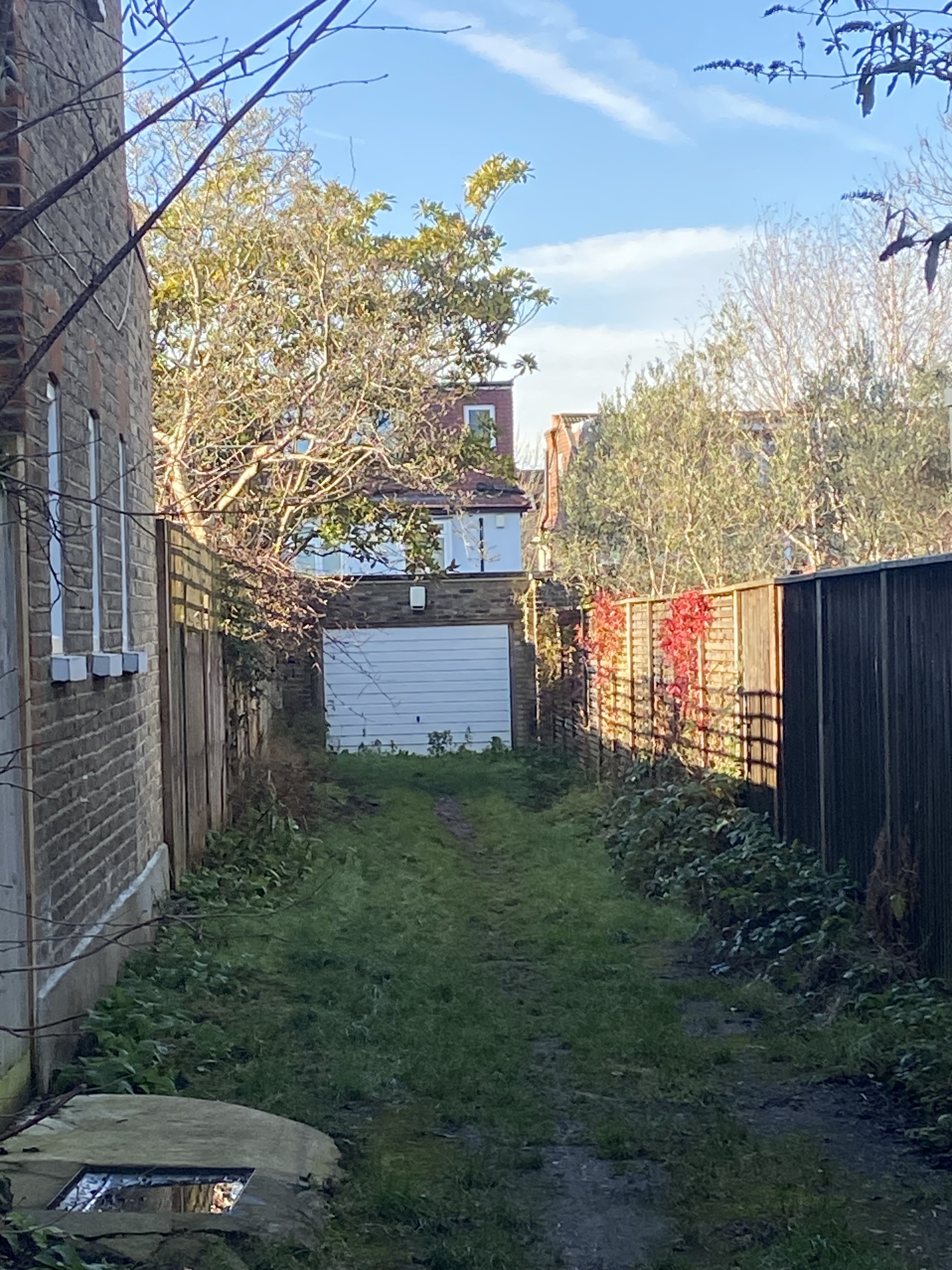
Between numbers 54 and 56 Palewell Park there is an alley known as Pale Lane, with grass along the verges left from the 17th century. It is a fragment of an ancient way from East Sheen to Palewell Common.
Pale Lane began on the east side of Milestone Green at the East Sheen crossroads leaving Sheen Lane near Larches Ave. It ran southeasterly, the Lane being part of what is now Park Avenue and on the West side of All Saints Church.
At the western end is the estate wall of the former Sheen House built by EJ Darley in 1867. Running along the wall was Alley Hill Footpath, originally intersecting with Pale Lane on the east side of the wall.
Pale Lane below: at the far end there is a path to the right behind a locked gate.
In 1807 Henry Hope of Sheen House wished to stop up and enclose the part of Pale Lane running through his estate on the South side of his kitchen garden and field. Under a writ of ad quod damnum he was given permission on condition that he made another road which is now the section of East Sheen Avenue between Park Avenue and the Upper Richmond Road.
On what is now Park Avenue at the crossroads with East Sheen Avenue was also situated the Mortlake Pesthouse described as a barn and garden for the isolation of people sick with the plague. Four poor families lived there until 1845 when Mortlake Vestry resolved to sell it for £200 to William Gilpin of the nearby Palewell Lodge.
On the east side of the Pesthouse, Pale Lane turned south and then southeast to Palewell Common. In present terms its course was on the east side of All Saints Church through back gardens and coming out at the southern end of Park Drive. On the way it passed on the east side Palewell Lodge which was demolished in 1925.
Pale Lane petered out near the end of the present Park Drive becoming a footpath shown on old maps but now gone. This ran along the common in a curving southeasterly fashion past the vanished original Palewell Pond in the northwest tip of the common. The footpath continued diagonally halfway down the common where it turned east across Palewell Fields and a bridge over the middle ditch. It crossed the Beverly Brook on a two arch brick bridge and thence into what is now known as Priory Lane.
Alley Hill Footpath became a back way to the houses in Palewell Park. Richmond Park Road was built on the western side of the Sheen House Estate wall part of which remains. All the rights of ways subsisting in the former footpaths were diverted into the pavements of the new roads.
With acknowledgement to the Barnes and Mortlake History Society
Alleyways of Mortlake and East Sheen by Charles Hailstone
from which this post is extracted and edited
Original edition published in 1982; latest edition published in June 2009
Ad quod damnum is a Latin phrase meaning “according to the harm” or “appropriate to the harm”. It is used in tort as a measure of damage inflicted, and a remedy, if one exists, ought to correspond specifically and only to the damage suffered.
Discover more from EastSheenMatters
Subscribe to get the latest posts sent to your email.


Fascinating. Thanks for the description.
LikeLike