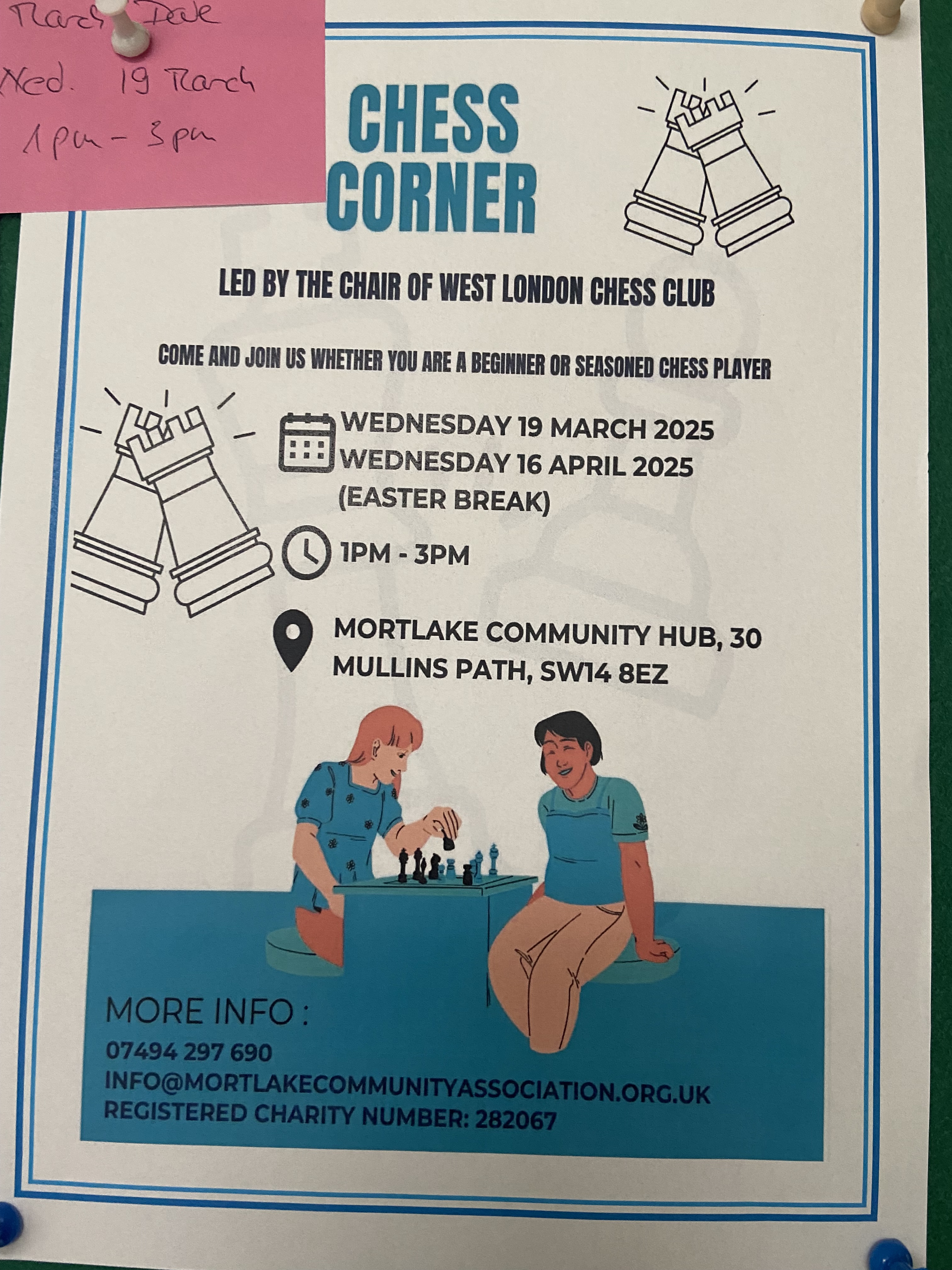
You can do better than the players on Sue Perkins’ Chess Masters!
You can do better than the players on Sue Perkins’ Chess Masters!
THURSDAY, 13TH MARCH 2025
Barnes Home Guard Club, 76a Richmond Park Road
Calling all music lovers! Whether you’re a seasoned musician or just love to jam, join us for an evening of fantastic music and community vibes starting from 7PM. Bring your instrument, warm up your voice, or simply come along to listen, soak in the energy, and be part of the fun. This month is FOLK music.
You can email Patrick at pjboundy2@gmail.com for an open mic slot or just rock up for the jam with instrument in hand.
Join the Time Trek Walk round Mortlake on Friday 14 March 2025. Meet at Platform 1 Mortlake Station at 230pm. About an hour with David and Helen Deaton
Many will have attended a service at Mortlake Crematorium for a loved one. It may seem a surprising place for a visit otherwise, but it is an interesting spot, and perhaps one where we should take a more detailed look before we need to use it.
It was licensed in 1936 under the Mortlake Crematorium Act 1936, thereby becoming the first to be established under its own Act of Parliament. The building was designed by Douglas Barton, an employee of the Hammersmith Metropolitan Borough Council. It was constructed in three years at a cost of £27,000. It was equipped with a Garden of Remembrance for the scattering of ashes.
The facility was finally opened in January 1939 by Lord Horder, the then physician to the King. Mortlake Crematorium’s outward appearance changed little over the following years until 1982, when Colin Gilbert, an architect from Ealing, designed additional gardens on the area of land between the crematorium and the river Thames.
In 2011 English Heritage listed the Crematorium as Grade 2. The citation stated that it was cleverly designed, with a variety of spaces, pleasing elevations and arcaded cloisters. The chapel interior is impressive spatially. See the original design below to which pillars have now been added.

The building has a distinctive Art Deco design that is little altered today.

Natasha Bradshaw has been the Crematorium Manager for fifteen years. She is a mine of information and very happy to organise tours around the building, the chapel and a behind the scenes look at the ovens! There are on average 2200 services in a year and they can do thirteen in a day. Staff can engage in a Cremator Technician Training Scheme.
On a tour you can see the process from movement of the coffin from the catafalque to the use of the ovens. At the end of the service the coffin will be rolled to a room behind the chapel. Unless the family wish to see the coffin going into an oven, it may not be burnt immediately. The ovens need to be heated to temperatures up to 900 degrees C, so several ovens may be heated at a time. A body must be incinerated within 72 hours. From the oven the ashes will go to a cremulator for further disintegration. Bones may be managed separately and for some Asian cultures retained.
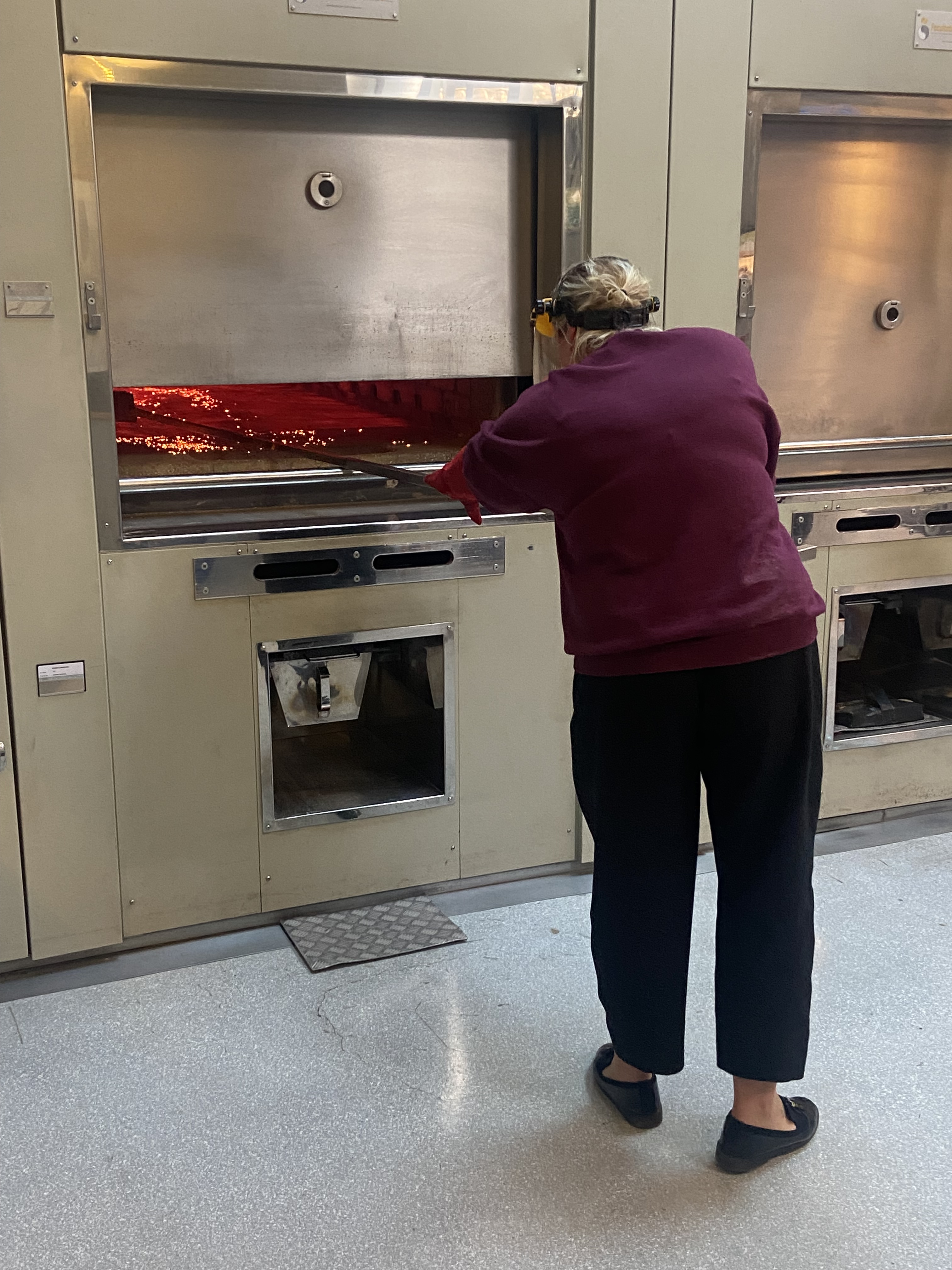
Metal parts which do not incinerate, like pacemakers, articificial joints or prosthetics are removed and also treated separately. They will be sent to a company in the Netherlands, which specialises in crushing them into metal which can be used for other purposes. The Crematorium receives funds in return which it then passes to charities.
The average time from death to service is fourteen to twenty one days but this is not because of delays at the crematorium, rather because of the preparation of plans for the service, printing orders of service and arranging the attendance of people from a distance. Time to say goodbye sung by Andrea Bocelli is the favourite tune!
Why is the cremation such an emotional event, given that the body will probably have been dead for fourteen to twenty one days? It is the last time you see the body, albeit in a coffin, plus a reminder of past memories.
Direct or Pure cremation is a new service, currently being heavily trailed on TV adverts, which offers to collect a body and return the ashes. Not quite the service you would get at Mortlake, it sounds a bit like a dumping ground for unwanted relatives!
Many famous people have been cremated at Mortlake, among them: Baroness Margaret and Sir Denis Thatcher, Sir Michael Redgrave and Dame Maggie Smith, Lord Longford, Sir Robin Day, John Profumo, Tommy Cooper, Kenny Everett and Charles Hawtrey.
Mortlake Crematorium supports and is supported by the Good Grief Trust www.thegoodgrieftrust.org , which has a website signposting immediate bereavement support.
For more information see www.Mortlakecrematorium.org or phone 020 8876 8056. Natasha has been interviewed for a podcast Living with Dying by Dilys Morgan which can be viewed at Episode 48: Natasha Bradshaw . See also www.angelanddove.com
Valentina’s Deli has announced that its East Sheen deli is currently closed due to a fire in the early hours today. Front windows and door have shattered and have had to be boarded up.
They have announced that online orders cannot be processed at this time and apologise for any inconvenience.
We wish Valentina’s a speedy resolution to the obvious problems arising.
On a more positive note Michel the Cheese has returned to the Pig and Whistle Car Park and will be there on Thursday, Friday and Saturday.
John Dee the renaissance scholar and scientist, came to Mortlake in 1566 and lived in a house opposite St. Mary’s Church in Mortlake. He was a favourite of Queen Elizabeth I, whether for his scientific or his occult knowledge is in dispute. It is known that she visited him in Mortlake en route to Richmond Palace on the death of his mother.
Dee led a remarkable life, regarded as a brilliant scholar, but also gullible in respect of his beliefs in angels and demons. He is said to have owned the largest library in England. Sadly on his death many books were removed, allegedly by those who knew their worth. He was a noted cartographer and coined the term British Empire. Items owned by him are in the British Museum and the Science Museum.
His estate was purchased to set up the Tapestry Works in 1619. The Queen’s Head was built on land bought after the closure of the Tapestry Works in 1704.
Many will be familiar with the Rest is History podcast series. They have recently broadcast an episode on John Dee, which has an hour’s worth of detail. Perhaps surprisingly there is no mention of the Mortlake Tapestries, though the foundation of the works came after his death.
https://therestishistory.com/episodes/
542. Elizabeth I’s Sorcerer: Angels and Demons in Renaissance Europe