Good afternoon One and All. And Welcome. And thanks to Sir Ivan
I prepared a speech and then wondered, as a white, male, elderly, middle class, allegedly privileged, lawyer, interested in cricket, whether I should tear it up and start again in the light of current media reporting.
But I didn’t because I can’t help being any of those things. And given I am one of the 80% of the white UK population I decided that any thoughts I have about advantage should be in relation to that 80%.
Looking around I can see only one brown face and no black faces. Dinshaw Master told me a few moments ago that he was the only brown face at the school in his time. There are a few disabled now, but that is largely from age. That all reflects the school in our era and I see no purpose in apologising for it. Of course we need to ensure we address current problems but were we to consider the population of BHASVIC now I suspect it would be very different.
When I was younger, I guess my ambitions would have included earning money, having a house, a car, and a family. I have achieved those but looking back, it has been the journey that has given me as much pleasure – the highs and lows, of life, work and sport, the people I have met, the places I have visited. I feel I have been fortunate and I doubt whether that journey would have happened without the grounding I received at our school. Talking over lunch to Norman Wright, the only Football Blue (1971) I know from the School he feels similarly. So thank you School for helping with the journey. My approach to today has been to look for the benefits I feel I accumulated from this School. How did they influence my life as a lawyer and my involvement in sport? And how did law and sport come together? At heart it is about friendships and connections in social life, work and leisure.
Of course I passed the 11+ but I was never an academic at school. I was reasonably good at cricket and I was selected to play for the School Under 14 team in my first year when I was eleven.
Later being cricket captain had consequences. I recall Stan Cave, the Under 14 manager and a delightful elderly northern gentleman, picking me out in class one day to ask what the first rule was. I had no idea what he was talking about. It was a maths lesson. How embarrassing! He had to tell me what was obvious TO HIM: keep your eye on the ball. Perhaps in modern parlance stay focussed on your primary objectives.
School chess also provided a regular but rigorous diversion from academic studies. Matches against other schools were regular features and less physically demanding than football. And who remembers the 430pm train journey to play Steyning Grammar School, until Dr. Beeching destroyed part of our history in 1963?
By virtue of outlasting my peers to a third year in the sixth form, ostensibly to apply for Oxford (there was no chance of that) but in reality to spend more time playing cricket, I became Head Prefect. This was something of a fulfilment of one observation of the Headmaster Harry Brogden, that my abilities were administrative rather than academic.
Nonetheless he encouraged me to apply to study Law at Southampton. I was offered a place by a Professor who must also have had an interest in cricket. I doubt I would have succeeded on academic merit but perhaps the Head’s reference helped out!
My Law Degree was not much to write home about, and my university career was based largely on chess in the winter and cricket in the summer. I captained some very articulate and useful young cricketers – not an easy task but it had benefits in later life.
In 1968 I returned to Brighton where I was offered articles with Sir John Donne, an old friend of my father, both of whom loved cricket. John sponsored me to join the MCC. In a remarkable coincidence of timing I was admitted as a Solicitor on 15 May 1971, the same day as I was admitted to membership of the MCC.
Recently I came across a press cutting in the Brighton Evening Argus of a case in which I represented a fifteen year old boy in Brighton Juvenile Court following an assault at the Annual School Athletics at Withdean. At the time of this case I had been a solicitor for six weeks. My defeated client had put a running spike through his opponent’s foot. My rhetoric described it as ‘just a scuffle’ which the headline writer picked up on. The outcome of a small fine rather than the custodial sentence my client might have expected, no doubt encouraged me to believe in my advocacy. But I was never sure whether the picture of a hot air balloon adjacent to the article was a comment in itself.
One lesson I took from the occasion was that it might not be what you know but who you know. The Chairman of the Juvenile Court Bench on that day was none other than Mr. H Brogden.
You can perhaps see a theme developing here – the interrelationship of school and work and sport.
In 1972 I started to think that a taste of London Life might be fun for a while. An old school friend, Richard Hunt, suggested I apply to the legal department in the local authority where he was working. So in October 1972 I moved to work in the Camden Legal Department. Richard told me recently that the deal was sealed in the men’s toilet. The Chief Solicitor told Richard he might as well appoint someone who was a friend of his. Equal opportunities was not then the force it is now.
Another old school friend, Doug Fraser, later my Best Man, helped my move when he offered me a space in his flat in Turnham Green in West London.
I also made contact with Roger Morgan, one of the best school cricketers who had been here two years ahead of me. He introduced me to Hampstead Cricket Club, a leading London sports club where I started playing in April 1973. There I also later met my wife Diana. We had two sons, both of whom I am pleased to say still play sport in their 30s.
I thought working for a local authority would be less onerous than family and divorce law in Brighton. How wrong I was. Camden employed me mainly to conduct legal proceedings in relation to the protection of children, which had become a major social issue following a child death in Brighton. I worked with some of the leading social workers, paediatricians and psychiatrists of the day. This led to national and international activities in that field, and offers to teach, write and research child law and to conduct child death inquiries.
I found it ironic that I developed my career writing, given that at school my English was the subject of justifiable criticism. The end of education is not the end of learning!
By the mid 1980s I decided there was more scope in running my own child law practice, which in large part through the hard work of my excellent partner, flourished in Croydon for over 20 years. We had a legal aid practice, advising children, parents and many children’s charities and developed an interest in adoption and education law.
In the early 1990s I was approached to become a part-time Chair of the new Special Educational Needs Tribunal. I sat on that Tribunal for 23 years, and in 2007 I got converted – by legislation – to a Judge – a rather more impressive title than a Chair.
I have two main purposes in tracking that personal progress – through family, school, helpful friends, fellow professionals. My experience has been that so often it is not one’s personal achievements that matter but those that you can develop in coordination with other helpful and maybe like-minded people, including old school friends. And the contribution made to the creation of the journey of others, colleagues, students and family, has been an important part of my journey.
In the last few years I have found a way to combine personal and professional interests. Child protection and adoption work forcefully showed me the hardships experienced by many children and their families. The Tribunal work taught me an enormous amount about their special needs, in particular in relation to physical disabilities and neurodiversity such as autism, dyslexia and ADHD, and the family struggles they can create..
But what I have learnt recently is how much sport and other physical activities, and the arts at large, can contribute to the inclusion, health and well-being of disadvantaged young people, in a way which we did not foresee in our school days. A look at the BHASVIC website shows just how far the educational system has changed with attention to equality, diversity and inclusivity.
Sadly consecutive governments, central and local, still fail to promote systems to support these needs and benefits. We have to look more to private organisations. Locally the community is really fortunate to have both Brighton and Hove Albion – where the Blooms have made a great contribution – and Sussex County Cricket Club and the Aldridge Academy – where John Spencer has done likewise – all provide important social benefits through their Community Foundations.
So in conclusion it has been an exciting and fulfilling, and perhaps unfinished, journey for me – from early school days to the present day.
I believe in the power of communities and shared ideals. My family and this school provided me with a foundation for combining that thinking and continuing to strive to work in that direction. Continuing contact with the Crew on Table 4, support for this event and for the regular Old Boys lunches now organised by Alistair Rapley in London provide opportunities for those discussions.
Two final thoughts. Does anyone know how BHASVIC is described on its website? Be a Happy, Active, Successful, Valued and Independent member of the Community. [PS I learnt later invented by Alison Cousens, Head of Safeguarding and Media at BHASVIC]
And secondly an allusion to the school motto Absque Labore Nihil. Noel Coward said ‘work is much more fun than fun’. I guess those two concepts fit my thinking pretty well.
So to you all – many thanks for listening to my journey and thanks again to the School for helping it to happen.
Richard White 1957 -1965
As you set out for Ithaka
Wish for the road to be long,
full of adventure, knowledge and discovery.
Laistrygonians and Cyclops,
angry Poseidon- don’t be afraid of them:
you’ll never find things like that on your way
as long as you keep your thoughts raised high,
as long as a rare excitement
stirs your spirit and your body.
May there be many a summer morning when,
with what pleasure, what joy,
you come into harbours seen for the first time;
Keep Ithaka always in your mind.
Arriving there is what you are destined for.
But do not hurry the journey at all.
Better if it lasts for years,
so you are old by the time you reach the island,
wealthy with all you have gained on the way,
not expecting Ithaka to make you rich.
Ithaka gave you the marvellous journey.
Without her, you would not have set out.
She has nothing left to give you now.
And if you find her poor, Ithaka won’t have fooled you.
Wise as you will have become, so full of experience,
you will have understood by then what these Ithakas mean.
On 24 February 2022 a warmongering billionaire tyrant, a latter-day would be Tsar of all the Russias, invaded Ukraine, an independent and largely peace-loving neighbour in mainland Europe. Western countries fulminated and imposed sanctions on a few of the tyrant’s gang but otherwise did nothing to protect its friend and neighbour. Baltic, Scandinavian and Central European States must now be fearful of further Russian expansion over the next decades and whether their allies will take any steps to stop it.
We can now see all too well the effect of a disintegrating Europe initiated by a disastrous politically motivated Brexit, both in terms of a unified policy and economically. We accepted an attempted assassination of a British resident by Russian agents and a consequential death of a British citizen. We subsequently continued to permit Russian investment in the UK, no doubt to the benefit of some of the London political and professional classes. We ignored the annexation of the Crimea. It was all a green light for a tyrant.
The consequences of a self-interested, inward-looking, incompetent Government, ill-equipped to combat a period of unrest and uncertainty will be seen for years to come.
Eighteen days on from the start of the invasion and after what appears to be deliberate bombing of a maternity hospital and numerous other massacres, what we should do about Ukraine? To date sanctions and the provision of weaponry to Ukraine have been put in place. Consideration of imposing a no-fly zone and putting forces on the ground have been dismissed in short order. Much of the policy thinking in the West seems to have been developed on the basis of a fear that opposition to Putin runs the risk of starting WW3 and / or the use of nuclear weapons. So allow the massacres and devastation to continue.
In Putin we have a man who is a cowardly bully and either mad or megalomaniac. In my experience of the concept of bullying it is necessary to confront the person. Until that happens they continue to act outside the boundaries of normal behaviour. Having got a taste for blood the lust for it increases. Although it is good to read that the Pope has somewhat belatedly after 17 days called on Putin to ‘stop this massacre’, this man is unlikely to respond positively to pious imploring. Nor will he worry that the Russian people will become impoverished by his actions. He appears to place little value on life.
While it may be improbable that he will immediately seek to reestablish his fantasy of a Russian Empire, once he has conscripted more armed forces, an onward march to Poland, Moldova and Estonia must be probable. He is only 69. His model is Stalin.
The West needs to construct a more coherent plan to bring this man’s evil activities to an end sooner rather than later.
But what do I know? I am 75 and it is my end of life which could be blighted or shortened and not my whole future. As I have thought in other contexts a younger generation has to make its own decisions and probably its own mistakes.
Ukraine Update
The war criminal remains undaunted 32 days on. His forces have surrounded one city, bent on starving 120,000 innocent civilians to death, and flattened other cities with cruise missiles, one a mere 50 miles from a western country. We allow genocide to rage unopposed except by feeble sanctions. Western politicians seem primarily concerned to protect their own immediate interests, with little concern for those dying an unpleasant death on their borders, or for the longer term consequences of unchecked barbarity.
The #StopRussianAggression video shown to the UN Meeting on 5 April 2022 is quite horrific and could prove to be a turning point. Russia pretends that Ukraine has invented the atrocities. Can anyone seriously believe that? How can the Russian Ambassador to the United Nations, Vassily Nebenzia and Sergei Lavrov Foreign Affairs Minister ever sleep?
If China continues to ignore what has happened it is in danger of becoming a pariah state as well. Day 40.
It is said that most Russians believe Putin’s propaganda. Does that make them accessories to murder?
After two months of unceasing aggression Russia continues its murderous campaign against the innocent and independent state of Ukraine. Putin’s sideback, the mad Lavrov, who calls himself Foreign Secretary, issues threats of World War III and nuclear attack, as a prelude to talks with the UN Secretary General, simply because Ukraine does its best to oppose its country being destroyed and its people murdered, raped and pillaged. Meanwhile the Russian population at large stand by and take no steps to oppose the mindless violence, heedless of the loss of 15,000 of its army, with many times that wounded, or the consequences of war for generations to come. [Updated 26 April 2022]
War exhaustion has set in after four months of ceaseless Russian barbarity. But renewed atrocity in bombing a shopping centre today causing the deaths of countless Ukrainians must surely make NATO rethink its policy of only arming them to defend themselves. Given the support Putin appears to have among his subjects, the war must be taken to them by some means to make them recognise the crimes that are being committed on their behalf. [Updated 27 June 2022]
Reading recently about the Holocaust it made me think that the only people I could compare Putin and his oligarchs to are Hitler and the Nazis. Sadly it seems they have the support of many of the Russian people.
24/10/2022
Regrettably this is what you get if you support a brutal, war-mongering regime which has no boundaries. Anton Krasovsky, the chief of Russian-language broadcasting live for the RT channel formerly called Russia Today, said Ukrainian children who said they were being occupied by Russia should be “thrown in a river with a strong undercurrent. Just drown these children. Drown them. Burn them alive.”
“Russia is being reduced by the Bolsheviks to an animal form of barbarism…Civilisation is being extinguished over gigantic areas, while Bolsheviks hop and caper like troops of ferocious baboons amid the ruins of their cities and the corpses of their victims.” Churchill in a speech in 1918. Plus ca change.
Russia retreats
Remembrance Day in the UK is memorable for the Russian retreat from Kherson, the only major city in Ukraine which they captured during their invasion. I cannot help but wonder how the Russian people can continue to be deluded about Putin’s claim that he was saving Ukrainians. It was a relief to see the joy obvious in Kherson today at their family reunions in spite of the privations visited on them by the invading barbarians.
Moving in to 2023 and eleven months on from the invasion Russia continues to send its men to the slaughter. At last the West has decided to assist Ukraine with tanks.
ONE OF THE FEW IN RUSSIA IT SEEMS
She imagines the muffled screams of those trapped under the rubble, the fire and smell of smoke, the grief of the mother who lost her husband and infant child beneath the ruins of the building in Dnipro bombed by Russia. She imagines being unable to breathe.
That is why she is here, at a statue to the Ukrainian poet Lesya Ukrainka, a largely unknown monument tucked away among Moscow’s brutalist apartment blocks that has hosted a furtive anti-war memorial at a time when few in Russia dare protest against the conflict.
“I don’t know what else I can do … I wanted to show that not everyone is indifferent [to the war] and that some people still have a conscience,” she says, her eyes filling with tears. It is the second time she has returned to place flowers at a makeshift memorial to victims of the strike on 14 January that killed 46 people and wounded more than 80. She passes it when she comes to visit her mother, who lives nearby.
This is the closest Russia comes to an anti-war demonstration these days. While Vladimir Putin’s announcement of the invasion of Ukraine brought thousands on to the streets last February, the government has methodically stamped out public dissent, arresting thousands and pressuring many more to flee the country.
Now, more than 10 days after the missile strike in Ukraine, a trickle of Muscovites still come to pay respects to those who died. An elderly man silently bows to the statue and crosses himself as he passes. Returning from class this week, Ilya, a student, bent over to read the memorials left at the statue.
I heard Michael Marmot speak at a zoom seminar of the Dartington Social Research Unit in the summer of 2021. If you google his name you will find a number of references to his work on health inequalities. What he told us at the seminar was that the government had commissioned a report from him in 2011. They then ignored it and introduced an austerity policy instead. He did a further report in 2020 which highlighted things like the consequences of this policy on death ages and rates and reduction in life expectancy – after ten years of unnecessary austerity and pre covid. It is obvious that the quality of life of the elderly and vulnerable must also have suffered.
The amounts wasted and given to a variety of dubious organisations has shown all too clearly how money can be found when the government wants to.
What we also now know is that for a variety of reasons the impoverished groups are less likely to get vaccinations.
And yet the population in sufficient numbers supports a government which continues to dictate these policies.
And MPs who know the Prime Minister has lived down to his reputation over many years of being a born liar also continue to support him. It is all about saving their own skins and finances and nothing about promoting the wellbeing of the country.
I always thought that when an apple was rotten the whole of it should be discarded, not just a few of the smaller pips.
I used to be proud to be able to call myself English, not for John Bullish reasons, but because largely I thought we had standards to be proud of: in legal terms Rule of Law, Separation of Powers, independent judiciary, many caring professional groups, who looked after the more vulnerable in our country and others, and sporting prowess! Scientists and the caring professions remain high in my estimation, but they are vulnerable to political manipulation.
The last high spot I can recognise is 2012 when the Spirit of the Nation was unified and we combined with other countries in a primarily positive way. I was a volunteer driver all round London for three weeks, during which time there were limits on our personal freedoms, especially on the roads. I cannot recall a racist or other social incident during the 2012 Olympics.
Since then of course we have had austerity, on which we now have research evidence to demonstrate that it has had a damaging effect on life expectancy (which must also mean other damaging consequences). And in 2016 we had the disastrous Brexit campaign of lies and deceit, which led to a developing understanding that government was increasingly able to tell lie after lie and flout the constitutional norms, without consequences to their political standing.
If you can lie about £350m on the side of a bus, what can’t you do. If you can create a Cabinet in your own image and appoint only second rate ministers who will do your bidding and sack the rational thinkers from government and party, what can’t you do.
If you can break the law by refusing, on a mere statement in the House of Commons, to implement a political commitment, enshrined in a statute, to provide foreign aid of .7% of GDP, what can’t you do.
And where I lose my pride to an even greater degree is that we have a Lord Chancellor, a man previously thought to have some decency) who can state in public that it does not matter what the Prime Minister does or says because he has public support, we have a majority of MPs who are willing to comply with that debasement of standards, and we have enough people in the country who support him for him to continue his lying, deceit, self-interest, cronyism. One woman is reported as saying during the Hartlepool election that she liked him because he was like her. So she admits to lying and cheating her way through life. It seems there are many like her.
The next hope for bringing the country together at least to some degree has been the EU Football in 2021. But it is now becoming increasingly clear that the government set out to destroy that hope, largely it seems because it feared the political impact of a country at one. We have white men rioting at Wembley without serious media comment. The police are looking for five people. Imagine if that had been blacks in Tottenham. We have government led racist abuse of some of our leading players. If the Trump cap fits wear it.
I feel little to be proud of in England or being English right now. And the threats to democracy only increase that feeling.
And now in mid August 2021 we see more evidence of this Government’s incompetence and hypocrisy, as the Taliban resume power in Afghanistan. All that loss of life has been wasted as this xenophobic, self interested cabal leaves a vacuum with potentially disastrous humanitarian consequences and almost certainly a return to a state in which there is little respect for women and ‘unbelievers’. ‘We did not expect it to happen so quickly’ says the Government, as thousands are stranded and at the mercy of religious fanatics.
Given the lack of an adequate government at present I have the following suggestions for a reshuffle.
Prime Minister Gareth Southgate Chancellor of the Exchequer Raheem Sterling Lord Chancellor Harry Kane Home Secretary Tyrone Mings Foreign Secretary Jadon Sancho Health Minister Kyle Walker Defence Ministers (joint) Harry Maguire / John Stones Northern Ireland Declan Rice Cabinet Office Marcus Rashford Education Jason Pickford Trade Kieran Trippier Work and Pensions Calvin Phillips Environment Mason Mount Housing Jordan Henderson Ag and Fish Luke Shaw Children Bukayo Saka Without Portfolio Jack Grealish They are all qualified for these posts in various ways and I venture to suggest maybe better than the present incumbents. It is a bit light on women but then so is the present Cabinet. RW
Where did it all begin? I guess I could say that I come from a sporting family. I have a photo of my father, affectionately known to all as Bertie (though Daddy to me) when he was captain of cricket and football at Xaverian College in 1931. My mother was Gwen and her father George is recorded as organising a company cricket match in 1926.
I have no cricketing memories before 1953, when I was nearly seven. Sussex played the all-conquering county champions Surrey at Hove. I believe I went to the game in late August but I have no evidence to support the vague memory. The game ended in a dull draw (if 100 from PBH May could be dull) but it featured my early cricketing heroes: David Sheppard, Don Smith, George Cox, Ken Suttle, Jim Parks, Ian Thomson, Rupert Webb and Ted James (in batting order of course). I later benefited from coaching from most of them at the annual Easter nets at the County Ground.
The following week I went with my father to the Farnborough Air Show on my seventh birthday. He served in the Second World War in the Royal Artillery and later in the Territorial Army and had considerable expertise in aircraft recognition. My main memory of that hot day is of being stung by a bee, but the images of the Javelin and the Vulcan Bomber were also implanted.
On 2 June 1956 Sussex played the Australians at Hove. Thomson, James and Smith dismissed Harvey, Miller, Benaud et al for 231 and Sheppard fell just short of a hundred in reply but rain intervened. By then the cricketing path was set.
I had first been to school at Lourdes Convent in the Preston Road in 1950 where my sister, Phillipa, was already a pupil. At that time we lived at 40 Springfield Road in Brighton to where we had moved in 1948, from 20 Bristol Gardens in Kemp Town, where the family lived when I was born at Brighton Maternity Hospital. As an aside a previous use of the building was premises for Brighton Grammar School.
We used to take the one mile twenty minute walk through Preston Park, including home for lunch, come rain or shine. The nuns were more interested in having us perform tableaux than sport. But by seven I had moved to Cottesmore Primary School in the Upper Drive in Hove, also a one mile twenty minute walk but up Dyke Road Drive and Highcroft Villas and down the Upper Drive. In those days there was not that much organised primary school sport, so what I did play would have been with my father in Preston Park in Brighton or while watching him play for Brighton Old Xaverians at their ground at Horsdean. I recall being at a game, and later playing, at the Xaverian College’s postage stamp ground near Queen’s Park in Brighton. It has now been demolished to make way for flats.
My most distinct sporting memory at Cottesmore was of making 49 in one innings of a rare match. I was mortified that I was then given out Hit Wicket by a teacher who did not know the Laws of Cricket, when I dislodged a bail as I was marking my crease for the next ball. He obviously thought my innings had gone on long enough without realising the impact of depriving me of the magic maiden fifty. There was also an occasional game of football, but no fond memories the main one being of taking a blow to the head from a ball kicked at short distance by Winston Weatherill (amazing how one remembers names from yesteryear), a rather more able opponent with whom I was later to play in the Pelham House Team at senior school.
My father was a teacher at Fawcett School, then near St. Peter’s Church, one of the more difficult schools in central Brighton for those boys who ‘failed the 11+’ . I met an old school acquaintance in 2022, who had been at that school before transferring at 13. He reminisced that my father was the only teacher who could quieten the class on entry to the room. Until 1959 he had a secondary weekend career in the TA as Battery Commander in Brighton and Hove. This enabled him to organise a Sussex Yeomanry v Surrey Yeomanry cricket match. In 1956 he persuaded the Duke of Norfolk, who was of course interested in both cricket and the TA, to permit the use of the cricket ground at Arundel Castle for the occasion. My father could only find ten players, or cunningly organised it so that I became the eleventh. It meant third man at both ends but to play at Arundel at the age of ten was really special. It brings back memories whenever I visit the ground, now for an annual county match when Sussex play there or to support the Arundel Castle Cricket Foundation in its efforts for less abled cricket lovers.
School
In 1957 I started at senior school, Brighton, Hove and Sussex Grammar School, having passed the 11+, a selection process which put supposedly more intelligent boys into a more academic school. Being a September birth but ahead of my peer group, it was a surprise to find that I was initially placed in a fast track class known as 1T. It lasted only one term before I moved to 1A but I later came to believe that this became a significant disadvantage because I think there was basic learning in Maths and English which without initial repetition went over my head. It was no doubt exacerbated by my primary focus being on cricket and chess.
In my second year the family conveniently moved to 6 Avondale Road in Hove. At the top of the road was the school playing field. The one mile walk became just a few hundred yeards and enabled me to continue to avoid the dreaded school lunches, with my home-making mother Gwen waiting to provide a decent meal.
Team cricket matches did not start until the third year, but being something of a cricket prodigy I was selected to play for the School Junior Under 14 team in my first year when I was only eleven. This was most unusual, especially as I was already one of the youngest in my year and in a sense, like my absence from school lunches, set me apart from my peers. I recall the team asking me if I used a box, as I surely had not by that time developed balls. purely in a physical sense. (The box was used as a protector since being hit by a cricket ball could cause significant discomfort to say the least.) Naturally by the time I got to the third year I was the obvious captain for the team. This continued at every level as I progressed through school. It could set me out in class as well. I recall the team manager and my class teacher, Stan Cave, a delightful elderly northern gentleman, asking me what the first rule was. I had no idea what he was talking about and he had to tell me the obvious: watch the ball. (Oddly enough as I write I hear discussion about the England wicketkeeper failing to catch the ball because he did not watch it into his gloves. A lesson not learnt in 60 years it seems.)
Summers in the early 1960s were idyllic and memory says largely sunny, unlike the winters which included being frozen in 1963. I extended my stay at school to a third year in the Sixth Form in 1963/4, ostensibly to apply to Oxford University, for which I was in reality wholly unequipped with which my interviewers agreed, but primarily so I could enjoy another summer batting and playing for Sussex Schools and Sussex Young Cricketers. That gave me treasured opportunities to play at the Hove County Ground, where I suffered a blow to the head from a bumper – pre-helmet days of course. I had in 1961 played for Sussex Schools against Surrey Schools at the Oval, an inauspicious occasion on which I was bowled Pocock nought. He did go on to play Test Cricket and captured the wickets of many more able batsmen than I was.
These dubious qualifications turned out to stand me in good stead. When I applied to study law at Southampton University the interviewer Professor Phillips showed little interest in my academic prowess and focussed largely on cricket. In spite of my poor A Level Results I was offered a place. My School Headmaster Mr. Brogden must have written me a good reference.
The highest standard of cricket I ever played was at Southampton University, where I started in October 1965. I played chess and studied in the first two terms and played cricket in the third. In those days it was possible to do that, at least in the first two years, unless you wanted a First, which was quite beyond my ambition or ability. Sadly that is no longer possible because of the dominant academic demands and the shortened timings of the summer term. Cricket as a national sport has suffered as a consequence.
The university side played at the Montefiore Ground, widely regarded as having one of the best pitches in Hampshire under the tender care of groundsman Ted Barrett. During the 1980s in a philistine move matching the decreasing importance placed on sporting excellence during the Thatcher era, the ground disappeared under concrete and was used for housing development. Cricket pitches and other sporting facilities were moved out to a far less attractive area known as Wide Lane. When I went back to play in later years it was to a soulless environment.
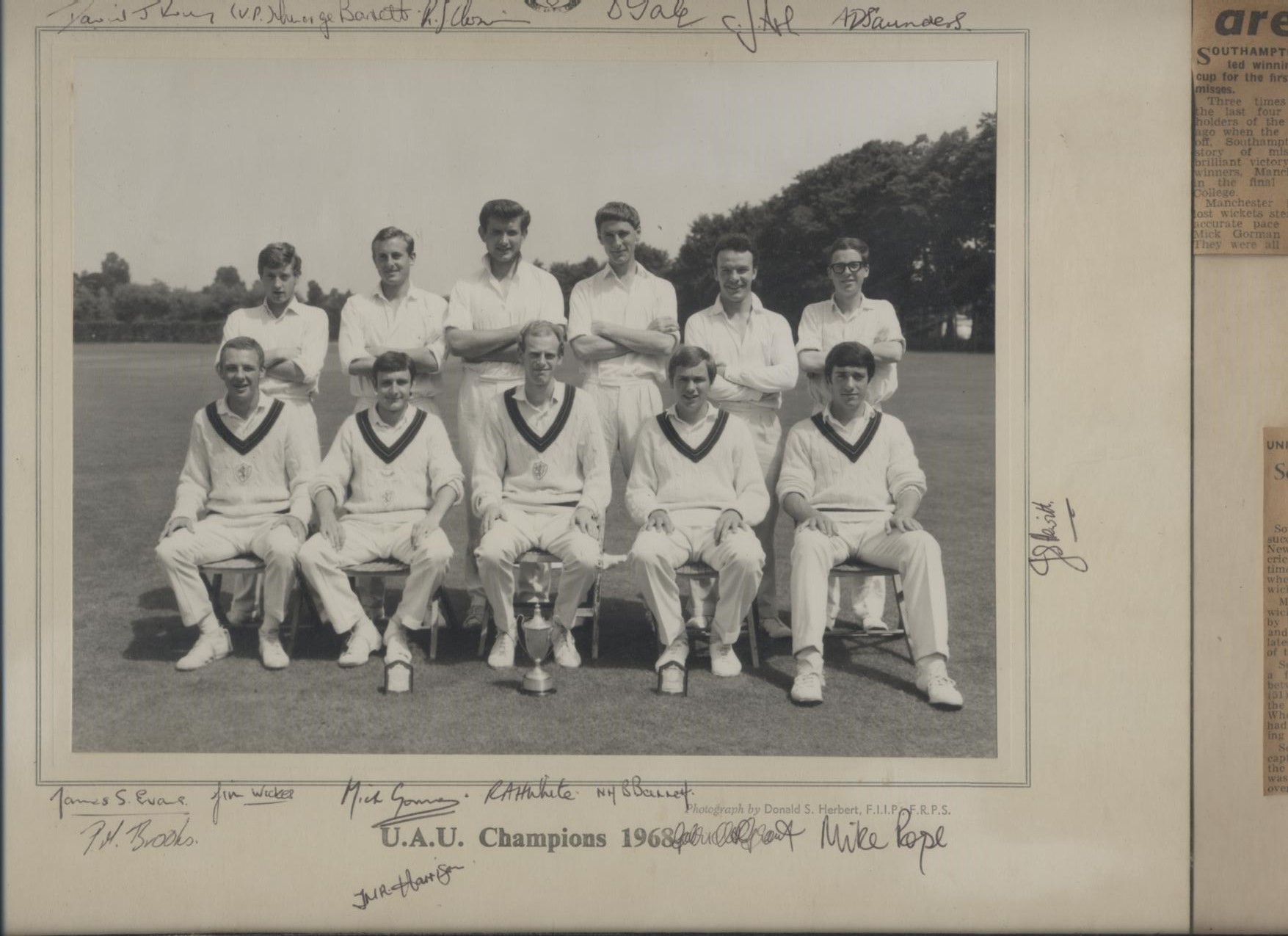
Southampton University Cricket Club had always been competitive in matches against other universities but when I arrived it had never won the University Athletic Union Championship (UAU). In my first season in 1966 I was fortunate to be selected regularly for the 1st XI. This was only by dint of keeping wicket to add that skill to my batting ability, which at this level was limited. I carried on as wicket keeper throughout my university career, unusual for a man of 6’ 2”.
Two main events were memorable in the season of 1966, when the First XI played under the captaincy of Tony Parkinson, a lawyer and a stylish if defensive opening bat. The early rounds of the UAU were not especially competitive but when we got to the semi-final we faced Loughborough University at Reading University in a game for which two days were allowed. At that time Loughborough was just starting to be the most competitive place to be with its focus on sporting achievement. It was a surprise to bowl them out for 161 but by the end of the first day we did not seem to be well placed. Early on the second day we declined to 137-9, when James Evans, an opening bowler not renowned for his batting, joined the author. To our mutual surprise we took the score to level pegging when we lost our tenth wicket to end the game in a tie. James was the survivor on that occasion, although sadly not later when his life ended prematurely. James always swore he would have won the game. We lost the reply when the author was unable to play, having been dragged reluctantly to an exam on the English Legal System.
The end of the summer term was in those days celebrated by a cricket tour to Torquay, to play a few local clubs of variable quality. Trips to Plymouth and the Devon hinterland necessitated travel in a convoy of cars, an arrangement which was only possible because the Road Safety Act was not passed until 1967. Cricket kit was of course in the car boot, including pads, bats and gloves. Having safely negotiated the hour’s drive from Plymouth, on arrival at the hotel in Torquay a following car stopped less quickly than the one in front. No more was thought of it until on arrival at a ground somewhere near Cockington, the boot could not be opened to give access to the kit of half the team.
In my second year I was Club Secretary, Colin Pinch was captain, a very fine left arm spinner and useful batsman, supported by Tim Davies, a highly skilled off-spinner, with support from Paul Clarke, another useful off-spinner when needed. My skills at keeping up to the wicket were certainly tested.
At the end of my second year at University it somehow came about that I was called up to play for Sussex 2nd XI – professional cricket. They must have been very short for a game at Worcester. Apart from an appearance at one of the most beautiful grounds in the country (when it is not under water) between the river and the cathedral, the game was notable for having eight Sussex sometime first team players. Worcestershire played Glenn Turner, who made 0 and 91*, and went on to play for New Zealand, and Sadiq Mohammed, who having had me caught and bowled for 16 in the first innings (I did not trouble the scorers in a run chase in the second innings) went on to play for Pakistan. (For further details see http://cricketarchive.com/Archive/Scorecards/28/28999.html )
In the third, and my finals, year I was elected captain of the club. This came about partly as a matter of seniority and having been secretary the previous year, because I was not the best player, who was usually the person appointed as captain. But as it happened I was a good captain (in my opinion). I had had years of experience, but managing a skilful group of intelligent students with diverse characters was much more difficult. I was also a good onfield strategist, which is more important in cricket than in other team games.
Probably the most significant event at University (even more important than graduation two weeks later) took place on 24 June 1968 when we won the University Athletics Union Cup in a match against Manchester University. Batting when the winning runs were scored was a highlight. For some years six of that team met regularly. In 2016 several of us went on a (non-playing but memorable) tour to India organised by Shiv Datt, a member of the successful 1970 side. We planned a fifty year reunion in 2018 of the successful cricketers, with the next two years teams who had the same success as we did.
Back to Brighton and Hove
I returned to live in Brighton (well with my parents in Hove Actually) on completing my degree in 1968. From the high of winning the UAU Final in July 1968 came the worst time of my life and little cricket. Life was dominated by travelling daily to Lancaster Gate in London to attend the College of Law to study for the Solicitors’ Professional Exams. Things improved but marginally when in February 1969 I succeeded in passing only three of the exam heads, the minimum requirement, which meant I had to spend the next six months studying for the remainder.
This was done part time however because in February 1969 I was fortunate to obtain articles with John Donne (later Sir John), Senior Partner of Nye and Donne, a long established solicitors’ practice in Ship Street, Brighton. My father had tutored John’s brother in the 1930s and had obviously done a good job, because John remembered. As an almost equal benefit John and his partner Geoffrey Seaton were both members of the MCC and put me forward for membership. This was accepted and I became an Associate Member on 15 May 1971. I was fortunate again when in 1973 the 16,000 Associate Members were given Full Membership in addition to the existing 2,000.
In a remarkable coincidence of timing I was admitted as a Solicitor on 15 May 1971, the same day as I was admitted to membership of the MCC.
I was also fortunate that, although John Donne was laid up with a bad back for some months during my articles so that I had quite a work burden, it was a great way to learn. He was also generous in allowing me to play cricket during the week. That enabled me to play for Brighton Brunswick during 1970, 1971 and 1972.
During 1972 I started to think that a taste of London Life might be fun for a few years. My thinking had been influenced by the amalgamation of three Sussex solicitors’ firms on 1 January 1970: Nye and Donne, Mileham, Scatliff and Allen and Coole and Haddock. Twenty three partners was too much for me and I vowed that if I ever looked to run a business it would be with a small number of people. My concerns proved well-founded when it later came to light that the newly established Donne Mileham and Haddock was defrauded of a six figure sum (a lot of money in the 1970s) by one of the partners and the firm’s accountant.
An old school friend, Richard Hunt, with whom I had stayed in touch, suggested I might like to consider working in the local authority where he was working. Yet again contacts proved useful and in October 1972 I moved to London to work in the Legal Department of the London Borough of Camden. Again I fell on my feet when another old school friend, Doug Fraser, let me know that there was a space in his flat. I was on my way to Turnham Green in West London.
I moved to London in October 1972. During that winter I made contact with Roger Morgan, one of the best cricketers of my generation who had been at the grammar school two years ahead of me. He introduced me to Hampstead Cricket Club and I started the nets there in April 1973. Apart from occasional trips back to Brighton to play for the Old Grammarians CC or St. James’s CC, there were all day Hampstead matches most Saturdays and Sundays around London and the Home Counties plus occasional midweek matches.
A few of us were recently discussing the history of Hampstead Cricket Club in the 1970s. That led to a rather personalised account. Any comments welcome. It might be a topic for a wet Wednesday at Lords. When I joined the Club in 1973 they had enjoyed a period of unparalleled success. For several years they had been able to field a side including blues and international or state players. They won the National Club Championship in 1969. In those days there was no league cricket, but two sides were often fielded on Saturday and Sunday and cup matches played on a Wednesday.
It was a Club full of larger than life characters. By 1973 many had moved on but some remained or arrived. Notable characters of varying skills in my time were Nic Alwyn, Richard Baker, Antony Berendt (and father), Sam Black, Chris Calvert, Richard Carr, Graham Chambers, Mike Farmiloe, Brian Field, Tony Goodfellow, Ken Henderson, Gerry Kelly, Peter Leaver, Derek Marchant, Nick Marchant, Paul Millman, Roger Morgan, Fergus Munro, David Norris, Roger Oakley, Jon Payne, David Peck, Andy Pollock, Bill Seldon, David Simon, Philip Sisson, David Tallon, Guy Townley, Russell Thomas, Jeremy Trevethick and Chris Winn were all good cricketers. Field and Oates frequently opened the batting, which could mean a morning watching them bat.
Players from Australia, Ceylon (as it then was), India, New Zealand, Pakistan and South Africa turned up cricket bag in hand. Alluding to current debates I would not have regarded the Club as racist even with hindsight. It was cosmopolitan even in the 1970s. If you were good enough you played.
The 1960s produced a stream of imports, who either connected at Oxbridge or were sent up the road by Lord’s. In the 1970s they were followed by Peter Cox (a more than useful Aussie left arm spinner, Eric Gillott, (a New Zealand left arm spinner, who dossed with me in Turnham Green for several weeks in 1973, before his socks led to exclusion), Mustafa Khan, (a highly skilled off-spinner), Iain Maddocks, (who could be relied upon for quick runs), and Russell Thomas, (an all-rounder, whose arm from cover caught out unwitting batsmen and sometimes fielders at square leg).
Jon Payne, a sugar broker, was an exceptional fielder though more of a golfer than a cricketer. He became a good friend and in 1974 with the benefit of a Camden mortgage we jointly bought a flat in Muswell Hill which we shared for four years. Most members were no doubt wealthy relatively speaking, many with views somewhere to the right. And it was something of an amusing juxtaposition that I worked as a solicitor for Camden Council, regarded as a left wing hotbed.
I will not record the many single figure scores but there were some highlights. Ninety against Old Parkonians on 7 July 1973 was followed by 50 at Gerrards Cross and 70 at Shoreham the day after a quick visit to Lords to see the end of a Sobers innings when he made 150* in the third Test of that summer. On 15 June 1975 I made 123 against Adastrians CC my career highest score and my only 100 for Hampstead. That was the night after a party given by Herbert Robinson, then Chief Solicitor at Camden Council and an MCC Member, a relaxed boss with whom I had some amusing discussions about cricket, not least about my appearance on TV sitting at the top of the Lords Pavilion on a wet Monday afternoon, when he thought I might have been in the office.
In early July 1975 I had a call from John Norman, a Hampstead member, who was match manager for the MCC match against Hampstead. He had heard I was an MCC Member; at that time I was ignorant of the fact that to play for the MCC you had to have qualified as a playing member. John convinced the MCC Secretariat that I was and on 2 July I got to make my debut for the MCC. I played one other game for the MCC against Southampton University Cricket Club, but by then the much loved Montefiore pitch had been destroyed and it was very different to the heydays of the 1960s.
On 27 January 1976 I went with a Hampstead Cricket Club touring party to Tobago for two weeks playing five matches. We played a two day game against Tobago Youth, who were far too good for us, a game memorable only for me being awarded Man of the Match for scoring 15* in two hours. Gerry Kelly contrived to lead us to a one run defeat against Tobago Ladies. We were batting left handed but I think they might have won anyway. We took a trip to Charlotteville at the far end of the island from where we were staying in Scarborough. A matting wicket was testing for us. Everyone turned out to watch what was probably the main event of the week, including the prisoner in the local gaol, who could observe from his cell window, always assuming he had recovered from the excesses of the previous evening. The most remarkable cricketing event was the winning catch by Philip Sissons in the gloom near the boundary off the last ball of the match. For me the most memorable social event was the beach barbecue, somewhere near Pigeon Point. Never a strong swimmer I ventured out into what I thoughts were the shallows. But no-one had told me that the currents initially swept you away from the beach, to deposit you back on land somewhere else. I soon realised I was unwillingly getting further away from the beach. Nothing to do with the consumption of rum of course. Fortunately the boatman was a strong swimmer and alert, as was Chris Cowdrey, our professional playing support.
Six seasons playing at Hampstead were memorable, full of cricket and social life, with some tennis, squash and bridge and not a little work. Of course in those days there were no women cricketers.There were tennis and squash sections, which added to the social environment. Sue Edwards, a physiotherapist, who played tennis at the Club moved into my Muswell Hill flat. And Sue introduced me to Diana Valentine, also a physiotherapist, who in December 1982 became my wife. There are other lifelong friends such as Jeanine Chambers.
My time playing cricket for Hampstead was curtailed when on 8 January 1979 I suffered a serious break of my right leg, ironically playing football for HCC on a Sunday morning. I had given notice to leave Camden Council two days earlier, but that very kind Herbert Robinson declined to process it as I was by then holed up in the Royal Free Hospital with my leg encased from balls to toes. A three week stay there was interrupted only by a trip to the Old Bailey to give evidence in a fraud case. Giving evidence while flat on my back and probably morphine affected, gave the defendant no chance.
When I was fit enough to play cricket it was in the 1980s and I started to play again in Sussex – nearer to my ageing parents.
Connections with Hampstead remained. In 1993 I helped to organise a charity match between the Hampstead President’s XI and the Mayor of Camden’s XI. Captaining a team which included Norman Cowans, Dilip Doshi, John Price and Neil Williams (even after their prime) and a brief appearance from Mark Ramprakash should have secured a rare win for the Mayor, but a typical 50 from Dr. Larry Baker (better known for his medical appearances at Lord’s) gave the home side a hard won victory.
There was an occasional Sunday side of irregulars called Hampstead Heathens, who played some attractive fixtures in odd places. Mike Willard, a Hampstead émigré, was always an entertaining player. A visit to Amersham Cricket Club was popular. Gemini Cricket Club was founded for the Dawson twins by their father and when we played them they were joint headmasters at Sunningdale School. In 1996 one week after my fiftieth birthday we played against Hurlingham Cricket Club, an exclusive venue in South West London. I made a century. Was it time to retire? Certainly the Heathens attracted fewer players and my playing became less frequent. I retained the Heathens flag but in 2023 it was donated to Hampstead Cricket Club.
When I returned to play it was in the 1980s and I started to play again in Sussex at St. James’s Cricket Club, who had by then acquired their own ground at Ditchling. This enabled me to spend weekends in Hove where I could more easily visit my ageing parents. It was another club full of characters, social activity and good cricketers,
I made two hundreds for St. James”s. Both had their amusing and memorable aspects. The first was at Horley on 31 May 1970. We were 11 – 4 when I was joined by off-spinner Ian Boyd-Pain who saw me to my hundred. The fulsome match reports in the local press were written by Ian, who later bowled us to victory with figures of 7-39.
The second was the following year against Preston Nomads CC, one of the better sides around Brighton and our main rival. The Club skipper for the day was the slightly eccentric but lovable ‘Sturge’ who was never without his pipe. But he had run out of tobacco. He left the ground in search. When he returned Bruce Lowe (who later emigrated to the USA and played cricket at the Cleveland Broncos baseball ground) and I had both made hundreds and with no-one to declare accumulated a score of 270 – 3, which even the renowned Nomads opening pair of Bidwell and Laing thought beyond them.
In 2000 we went on a family holiday to Kos with Mark Warner, a well known travel company for London families. An enterprising Oval employee had set up a cricket match. I met Tim Young, a cricketing barrister, who ran his own team Thebertons CC, who played half a dozen games a season in lovely grounds around the Home Counties. Perfect!
From more than 60 years of living with cricket I still having friendship groups at every level: Cottesmore Primary School, Brighton, Hove and Sussex Grammar School, Southampton University, Brighton Old Grammarians, St. James’s Cricket Club (near Ditchling in Sussex), Hampstead Cricket Club, Hampstead Heathens, Thebertons, Bank of England Sports Club.
In 2008 I retired from playing. There were two reasons. First my inability to get down quickly enough to a ball passing my feet or to move five yards to my right on the boundary was becoming an embarrasment. Or to react quickly enough to take a catch at slip. I recall missing one which hit me in the chest. I caught one a few balls later as it passed me at speed but I realised it might have hit me between the eyes. Secondly it was increasingly apparent that while I could still score runs playing at club level, I was at risk from beamers and bouncers. I played in a pre-helmet era. I was hit on the head three times, once at Hove, once in the nets at Lord’s and once at the Bank of England Sports Ground in Roehampton and only once suffered concussion. It would not have troubled me to have ended my days felled at the wicket, but the greater and increasing risk was of suffering brain damage and becoming a cabbage.
For fifteen years or so from the mid nineties cricket was more focussed on encouraging sons, Andy born in 1984 and Nick born in 1987, to play cricket at Hampton School and the (sadlt now defunct) Bank of England Sports Club. Both had skills but not the same level of enthusiasm as their dad. But what they did inherit was enthusiasm for and recognition of the benefits and importance of sport. So in my later years it has been the football touchline watching Andy playing at Hampton School and beyond and Nick playing tennis around South London including at the Lawn Tennis Association and Putney Lawn Tennis Club.
Nothing has changed since I wrote in December 2020. Covid is Johnson’s Falklands. The NHS is the British Navy which keeps him afloat. Or more accurately the hardworking front line staff which have dealt with crises in spite of its inadequate preparation for a pandemic and the bumbling decision making since. And for that the politicians claim the merit, which enables them to continue to deceive a significant part of the population.
The next stage is for this government to tighten its reins on power by ever more dubious unconstitutional methods. Unless those who recognise what is happening to this country can find a way to halt the megalomania.
For the record I felt it necessary to set down my views on events during 2020. Not by way of aggrandisement but merely to illustrate my experience I set out my career. My blog is not widely available and it is the only place where it will be published.
I was born in 1946 shortly after the end of the World War II. My parents were involved in local politics from my teenage years, so while I may not even then have been sympathetic to their thinking, I was familiar with the debates. I would have been regarded as a conservative head boy at Brighton, Hove and Sussex Grammar School, not especially academic and more interested in cricket and chess.
I was at Southampton University from 1965 to 1968 seeking a Law Degree but disinterested in the student demonstrations of 1968. I undertook articles with Sir John Donne in Brighton and then qualified as a solicitor in 1971 working in Brighton. I moved to the Legal Department of the London Borough of Camden in 1972, where during that decade I had my first close experience of politics. I played cricket at Hampstead, where I was regarded as a leftie, while my friends in the local authority, especially among the social workers with whom I worked, probably saw me as a right winger. On the one hand I had little sympathy for their strikes, or the later miners’ demonstrations, but on the other I recall furious arguments with my father about the demerits of Thatcherism. As an aside I note that at least she had principles and you knew what she was about.
Throughout the 1970s I was involved in the legal side of child welfare work, eventually writing with a leading academic, Professor Nigel Lowe, and developing multi-disciplinary activities, which included working with government departments, but in truth until the 1980s, although the political environment was part of my everyday life, the practice of it was a bit of a sideshow.
In the early 1980s I undertook research on children in care with Margaret Adcock, a leading social worker, and started training around the country, which increased my insight into the widespread shortcomings of services and provision for children and families. In the mid 1986 with Michael Sherwin I established a solicitors’ practice, which was to become a leading exponent of child law. About the same time I started work on children’s legislation which led to writing about the Children Act 1989. Later I chaired some dozen child death inquiries. Increasingly I was engaged with central and local government departments, politics and politicians and the mechanics of legislating and legislation, as well as the judiciary and professional organisations.
After implementation of the Children Act in 1991 I began to look towards judicial work and in 1994 was appointed as what later became known as a Tribunal Judge deciding cases relating to special educational needs. In 2008 my jurisdiction was extended to include appeals against Department of Work and Pensions decisions about welfare benefits. I continued as a Tribunal Judge until 2018.
So I have had a wide-ranging experience of the legislative, parliamentary and administrative systems of this country and held influential positions as a Judge, Honorary Professor of Law, Solicitor for many different types of client, Chair of professional organisations and author. My professional life has looked for coordination and resolution not confrontation.
That brings me to what has been happening in 2020. I have to start by stating that I am committed to the concept that the United Kingdom should operate within structures that align us with our nearest neighbours. I am probably influenced by having been born at the end of a war involving those neighbours and which had a malign effect on my early years. It is not an experience I would wish on future generations.
The 2016 Referendum asked the electorate to express a view on whether the United Kingdom should exit from the European Union. By a small majority they voted in favour of leaving. They were misled on issues about immigration, the bases of decision making in the UK and in the EU, described by some as sovereignty, and the economic consequences of remaining or leaving. The Government of the day, pressured by its right wing which has always been anti-European, decided to leave. In my opinion what has effectively happened over the last four to five years has been a right wing coup engineered by a small group of narrow-minded, politically powerful people who have taken the opportunity to advance their personal and financial interests. They have manipulated an uncomprehending population, with little understanding of the concept of sovereignty or how our state is managed. Many wanted a return to a Britain long since past. Many have long felt disenfranchised and saw nothing to lose by leaving the EU. Little did they know that things could get even worse.
I have concluded that in order to carry out this coup the last four years have been notable for the most dishonest and incompetent governing I have had the misfortune to observe in the fifty five years I have described above. In 2020 we have a Cabinet chosen solely for their adherence to the one guiding principle of removing the United Kingdom from the stable political environment in which it has flourished for forty years. Power has been centralised to emasculate any opposition there might be. Ministers all appear more concerned with the impact on their political futures than on the effects on the well-being of the population. Regrettably this has coincided with the most extreme and incompetent Opposition the country has known for a generation. They all know that the economic effect of of the guiding principle will be to lower living standards. On the fraudulent basis that the country will take back a sovereignty it had never lost, we move into national isolation and a reduction of international influence, so important to the way in which the United Kingdom has functioned for generations.
We have a Prime Minister best known historically for being a bounder, a chancer and a liar; a Foreign Secretary, who didn’t know where Dover was, a Home Secretary best known for being a bully, an ignorant, vacillating and pusillanimous Education Secretary, the Cabinet Minister whose political decisions vacillate depending on current ambition, a Minister of Justice not noted as being a man of action, an Attorney General willing to ignore the rule of law and a Health Secretary unable to manage the simplest of agencies within the NHS. All are willing to pay organisations enormous amounts of money to provide services about which they have no known competence. All have been under the sway of a self-important political appointee, only too willing to impose constraints on the populace at large, which he chose not to follow himself. I see no reason to trust what they say or adhere to what they dictate.
For four years these people have been wholly preoccupied by this political drive, to such an extent that other considerations have been put to one side, with the consequence that the country has been ill-equipped to deal with any difficulties. Into that environment steps Coronavirus, considered by many to be the worst health crisis facing the country in the last hundred years, with economic effects which are probably the worst since World War II. The pandemic has undoubtedly created problems which would have been difficult for a competent government with outstanding leadership to manage. We are unfortunate to have quite the opposite at this critical time.
I no longer watch government announcements or party political broadcasts about the virus. I see no reason to trust what they say or believe in their competence to make decisions about its management. I filter what I can from more reliable sources. I keep informed about government diktats but whether I follow them will depend on my and my family’s personal circumstances and a general desire not to risk wider transmission of infection. That is not to say that I have not followed guidance but my current circumstances are such that I have no reason to believe I have a real risk of exposure. I recognise that guidance has to be applied on the basis of benefit for the population at large, but given my observations of the lack of exercise of personal responsibility among large numbers of the general population or among politicians, their safety is secondary.
So in conclusion we have the most serious health crisis in a century and implementation of the most serious and contentious political decision in the last seventy years, when we have the most incompetent and untrustworthy government in my lifetime. It is all most regrettable. I am comforted only by the belief that honest, right-minded people will in due course thrive.
It is primarily a convenient site for me to record an important part of my professional life for posterity, if anyone is interested. It is also a self-justification for what I now hope to achieve.

I have been interested in writing and editing since the 1970s in connection with my practice as a children's solicitor. In 1976 while working for the London Borough of Camden I was invited to become an Editor of Clarke Hall and Morrison, the leading encyclopaedia of child law. I remain a Consulting Editor.

In 1978 I set up and became the first editor of Child Abuse Review, now a well-established multi-disciplinary journal. Subsequently I created a similar journal for children's lawyers. The first of two editions of Wards of Court, a unique High Court jurisdiction, was also published in that year.

Between 1982 and 2000 I chaired ten inquiries about the deaths of children at the hands of their family and about sex abuse in children’s homes.

In the late 1980s I co-wrote the first edition of the Children Act in Practice, which ran to its fourth edition in 2007, a major innovative piece of legislation in 1989 which still survives today. This was followed in 1991 by Significant Harm, elucidating the central concepts of care proceedings. For ten years in the 1990s and early 2000s I wrote a monthly column on family law in the New Law Journal.

Twenty years of writing judgments on decisions in the Special Educational Needs and Disability Tribunal and in the Welfare Benefits Tribunal between 1995 and 2017 maintained the critical eye necessary to write for publication.

A brief attempt to write and self-publish fiction in 2015 proved less successful but the output can be seen at


All these activities have illustrated the importance of good communication but also the difficulty of developing reliable sources of information and news and well-informed opinion. Whether this can be achieved in a local context remains to be seen.

Richard White
4 May 2024